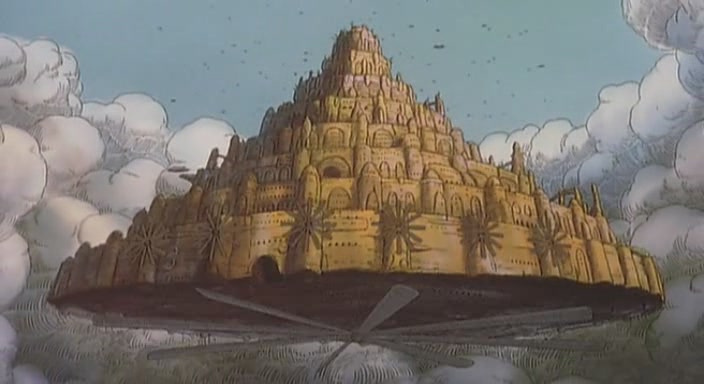
Laputa is mentioned in Gulliver's travels. It would wage war on cities by blocking out the sun or squashing them.
How does the island stay afloat? According to travels its with adamantine, and magnetic fields. I find very beautiful the mechanical nature of the floating island and the impossibility of that nature.
A thousand propellers blowing in the wind, a thousand rocks hanging in a hug of clouds.
Scarpa’s Ca’foscari is his first step
in establishing his legacy as a master of craftsmanship and restoration.
Ca’foscari, now a university, was initially a palace built in 1453 by the Doge
Francesco Foscari in the Venetian gothic style. His intervention in 1936
reinterpreted the gothic polifora of the loggia by the addition of new windows.
Scarpa’s sensitive approach to
restoration is what makes his work so rich. Instead of simply repairing the
building, he reconstitutes it by reiterating the past and present as a cohesive
whole. He manipulates materials so their forms echo and magnify each other, as
in his addition of the contemporary fenestration that responds to the harmonies
and proportions of the gothic portals. He creates a sort of double vision, the
gothic stone one and the contemporary glass and wood one, that merge to create
a whole that is sensible to the insights of both his time and the past one.
Similarly, this simulacrum is the
restoration of a pair of glasses from the 1930’s. A new frame is created by the
connection of the metal allen keys with the old one. A double vision is thus
induced by the interaction between the various frames. New and old qualities are
independent yet enhance each other. Scarpa’s conversation between the past and
present transcends issues of style; it addresses their fundamental qualities.
What does restoration means, and how can architecture reasserts itself within an existing context?
Violet Leduc defined restauration as the reestablishing of finished state, instead of repairing or rebuilding an edifice.
Ruskin, was more interested in thinking of the building as a representation of nature and as an analogue for natural process such as aging. His approach can be summarized as:" let the building die" because the decay and fragments could be beautiful, even sublime.
Although the two have contrasting views, they both agree that replacement and duplication are not the solution when it comes to restoration of historical edifices, because of the integrity of the building materials.
Scarpa's approach was different from the two of them. He didn't want to intervene to "recover" the original architecture, to to "update" the building. In recovery, the building was restored to an finished state of its former existence.
http://flickriver.com/photos/seier/4923748309/
Tour the university
http://www.fondazionecafoscari.it/?q=node/83
An overpass always casts a shadow.What to do under that shadow. We like to climb high but on a bike a ladder is not so efficient. The shadow cast by the bike masks the land underneath. What to put there, what to do there?
They are like gates we don't want to wander through. We want to ride the snake or walk the desert.
Giant dinosaurs frozen in a moment of doubt, when will they raise their stumpy leg to squash us flat?
Can a home live there? whats the difference between punting under water highways and crouching in the shadow of land lanes?
In some ways these are giant monuments to movement. is this why it feels so awkward to pause in their shadow?